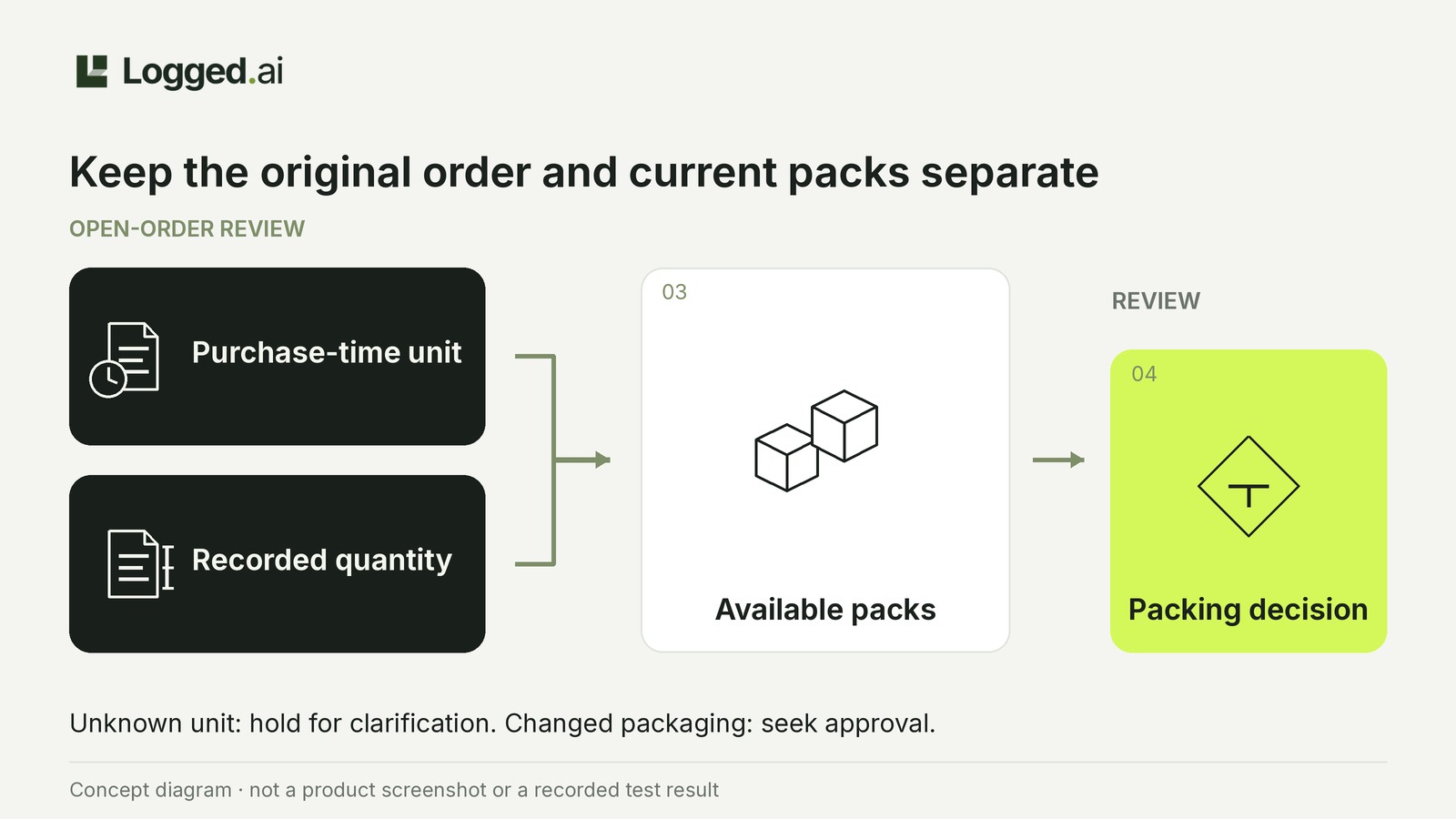
Do not use today's case size to calculate a picking quantity for an older order. First establish what one ordered unit meant at purchase. If that meaning is missing or contradictory, hold the affected line for clarification.
Keep three facts separate: the recorded order quantity, the purchase-time unit of sale, and the packaging available now. This is a manual fulfilment review, not a legal determination of order terms.
Identify the orders at risk
Find unfulfilled lines containing the affected SKU or variation and pack option. A shared product name does not establish that two variations had the same case size.
Record order references, placement times and timezones, marking unknowns. Compare known timestamps in one timezone. Use reliable dated evidence to narrow the review window; if timing is uncertain, keep potentially affected open lines in scope rather than treating one edit timestamp as a definitive boundary.
Flag those lines for review in your fulfilment process and name a decision owner. For partial dispatches, gather records of physical quantities already sent.
Establish what the quantity represented
Read retained order-line details and the original confirmation actually sent, where available. Look for an explicit unit definition: individual pieces, cases of a stated size, or another agreed unit.
Separate purchase-time values from later amendments and details drawn from the current product. A newly generated document is not necessarily what the buyer originally received. Do not assume custom pack fields retain history or combine quantities and unit definitions from different instructions.
- Order-linked purchase-time wording can support what quantity meant for that order.
- Dated pack specifications can support case size only if the exact SKU or variation and applicable dates match.
- Current warehouse labels and stock checks help verify available packaging, not the purchase-time unit.
A supplier specification alone does not establish the buyer-facing unit definition. A bare quantity of '2', an unchanged SKU or today's price is not enough to establish a historical case size.
Resolve contradictions without rewriting history
Suppose, hypothetically, the original confirmation says 'case of 12' but another retained order record says 'case of 6'. Preserve both statements, their dates and source references.
Look for a dated, authorised amendment. A nearby catalogue edit proves neither why the order differs nor buyer consent. An absent change record does not prove no edit occurred.
If the conflict remains, ask the decision owner to obtain clarification of the item, quantity, unit size and acceptable packaging. A new agreement is not proof of purchase-time wording.
Preserve historical unknowns and contradictions. Record any newly agreed fulfilment instruction separately with its date, scope (full line or remainder), explicit physical-unit total, pack size, owner and approvals, including any required customer agreement.
Do not calculate a historical total from an unsupported unit definition or rewrite historical details to match today's catalogue.
Choose packing, substitution review or a hold
With a supported historical case definition and relevant contradictions resolved, multiply ordered cases by units per case. Do not apply a case multiplier to a piece-based line.
Matching goods and packaging can support proceeding under normal checks. Different packaging needs substitution review even when the piece total matches. An unresolved unit definition requires a hold until clarification produces a usable, approved instruction.
These hypothetical outcomes illustrate decisions; they do not check stock, grant approval or save your record.
TRY THE SCENARIOS
What changes when the available case size differs?
Hypothetical unshipped line for the same goods: quantity 2; today's catalogue lists six units per case. Historical evidence and available packs vary below.
Twelve-unit cases confirmed, matching stock available
Purchase-time evidence supports two twelve-unit cases: 24 units. Recommend those two cases for packing under the usual release checks.
Twelve-unit cases confirmed, only six-unit cases available
The supported target remains 24 units. Four six-unit cases would match that total but change the packaging. Seek authorised substitution approval and any necessary customer agreement before release.
Purchase-time case size missing or contradictory
Do not calculate a target from today's six-unit description. Hold for clarification; preserve the historical unknown or conflict even if a new instruction is later agreed.
Compare all scenarios
| Situation | What happens |
|---|---|
| Twelve-unit cases confirmed, matching stock available | Purchase-time evidence supports two twelve-unit cases: 24 units. Recommend those two cases for packing under the usual release checks. |
| Twelve-unit cases confirmed, only six-unit cases available | The supported target remains 24 units. Four six-unit cases would match that total but change the packaging. Seek authorised substitution approval and any necessary customer agreement before release. |
| Purchase-time case size missing or contradictory | Do not calculate a target from today's six-unit description. Hold for clarification; preserve the historical unknown or conflict even if a new instruction is later agreed. |
Illustrative examples. Your selection is not saved or sent, and changes no store settings.
Account for partial dispatches
For partial dispatches, subtract verified units already sent from the supported full-line target. If either input is unknown, hold for reconciliation or obtain an approved instruction explicitly covering the remainder.
Do not subtract earlier shipments again from a remainder-only instruction, or convert past shipments using today's case size. If the balance is zero or negative, reconcile the open line rather than issuing a new pick.
Leave a decision the picker can verify
Keep a restricted fulfilment note for each affected line, recording supported values or 'unknown' and omitting unnecessary customer details.
- Order line: Order reference, SKU/variation, pack option, order time and timezone, recorded quantity.
- Historical basis: Unit of sale and units per case, or unknown; dated evidence references and unresolved contradictions.
- Quantity reconciliation: Supported full-line target and its basis; verified dispatched units; remaining units, or unknown.
- Packaging and proposal: Available packs and verification source; proposed pack count and unit total.
- Instruction and approvals: Basis (historical evidence or new dated agreement), scope, approval status and references, and final packing instruction if approved.
- Decision: Proceed under normal checks, substitution review or hold; named owner and next action.
Hypothetical completed entry
Order EX-01, SKU CASE-A, case option; placed 4 June at 09:15 UTC; recorded quantity 2.
Retained confirmation C-01, sent on 4 June, says 'case of 12' for that line; no unresolved contradiction appears in the reviewed sources. Full-line target: 24 units. Dispatch record: 0 sent. Remainder: 24.
Warehouse check W-01 on 6 June shows only six-unit cases available. Proposal: four six-unit cases, 24 units. Basis: purchase-time evidence with a packaging substitution. Decision: substitution review; approval pending; no approved substitute packing instruction.
Owner: Alex, fulfilment lead. Next action: obtain authorised substitution approval and any necessary customer agreement, then record the dated approval and final packing instruction.
Before release, have the picker compare the approved instruction with the actual goods, quantities and labels. This review does not replace payment, stock or other fulfilment checks.
Start with one affected order line. Ask another staff member to trace its proposed quantity to the cited historical evidence or a separate approved agreement, without treating today's catalogue as purchase-time evidence.